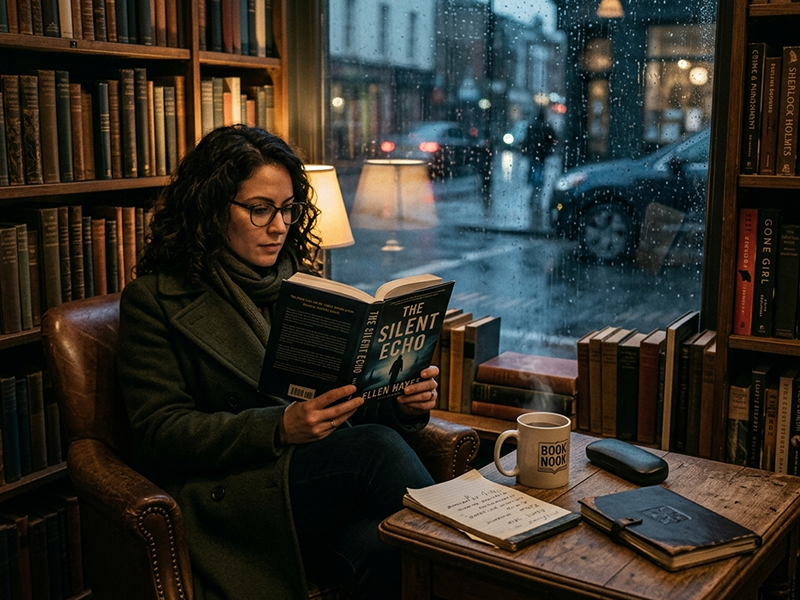
From bone-chilling twists and cleverly inserted puzzles to intriguing main characters, there’s something oddly satisfying about uncovering the truth before the great revelation. And that’s exactly what draws readers to pick one mystery fiction book after another.
But what actually makes a mystery work? Is it the dark secrets, the morally gray protagonist, the clever plotting, or the surprising emotional storytelling? That’s exactly what we’ll be diving into today! So, without further ado, let’s break down the key features of a truly captivating mystery fiction.
A Strong Hook That Doesn’t Give Too Much Away
A great mystery rarely begins with full clarity. It starts with a disturbance. Something slightly off. A missing person, a strange detail, a quiet inconsistency that lingers. Readers don’t need answers right away. They need a reason to care.
Some of the most memorable mystery fiction books open with questions that feel small at first but grow heavier with every page. That escalation matters. If everything feels urgent from the first paragraph, it burns out too quickly.
Characters Who Feel Like They’re Hiding Something
Flat characters ruin the mystery faster than a predictable plot. Everyone in a good mystery should feel like they’re holding something back, even if it’s harmless.
That doesn’t mean making everyone suspicious in an obvious way. It’s subtler than that. A hesitation in dialogue. A detail that doesn’t quite match. A reaction that feels just slightly off.
In many standout mystery fiction books, the protagonist isn’t even fully reliable. Not in a dramatic, twist-for-the-sake-of-it way. Just human. Biased. Limited in what they see or choose to see. That tension between perception and reality is where things get interesting.
Clues That Reward Attention
Here’s where a lot of stories stumble. Either the clues are too hidden to matter, or they’re so obvious the reader solves everything halfway through. The best mystery fiction books walk a narrow line. They plant clues early, let them breathe, and trust the reader to connect the dots later.
When you reread a strong mystery, those clues feel almost obvious in hindsight. That’s not an accident. It’s a careful construction. If a twist feels like it came out of nowhere, it usually means the groundwork wasn’t laid properly.
Pacing That Knows When to Slow Down
There’s a temptation to keep things constantly intense. But mystery thrives on contrast. Quiet moments matter. They give readers time to think, to doubt, to form their own theories. Then, when something shifts, it hits harder.
Some of the most engaging mystery fiction books take their time in unexpected places. A conversation that seems ordinary. A scene that feels almost too calm. Those are often the moments where something important is being set up.
Atmosphere That Feels Alive
A good mystery doesn’t float in empty space. The setting should feel like it has weight, like it’s influencing what’s happening. Think about it. A crime in a sleepy town carries a different energy than one in a crowded city. The tone shifts. The stakes feel different.
In well-crafted mystery fiction books, the environment adds tension without announcing itself. Weather, noise, isolation and even the layout of a place can quietly shape the story. It’s not just where things happen. It’s how that place feels.
Twists That Feel Earned
A twist should make you pause. Maybe even flip back a few pages. Not because you’re confused, but because you suddenly see everything differently. That’s the difference between a cheap twist and a meaningful one.
The strongest mystery fiction books don’t rely on shock alone. They build toward something that feels surprising but inevitable. You didn’t see it coming, but you understand why it happened. That balance is harder to pull off than it looks.
A Personal Touch That Sets It Apart
Plot can draw readers in, but voice is what keeps them there.
Take Paws and Rewind: A Tale of Murder, Mystery and Mayhem by AG Chacon. Amongst the best mystery books, it doesn’t just follow a mystery structure. It leans into personality. There’s a sense of playfulness woven into the tension, which gives it a slightly different flavor than more traditional mystery fiction.
That kind of individuality matters. Readers don’t just remember what happened. They remember how it felt to read it.
The Final Words
It’s rarely just one element. It’s the way everything works together without drawing attention to itself. A compelling question. Characters who feel layered. Clues that respect the reader. A world that feels real enough to step into.
The best mystery fiction books don’t just ask “what happened?” They make you care about why it happened, and who it changes along the way. And maybe that’s the real hook. Not the mystery itself, but the feeling that solving it actually means something.